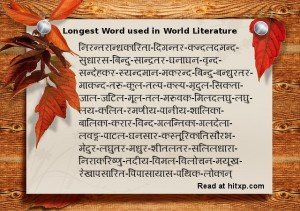
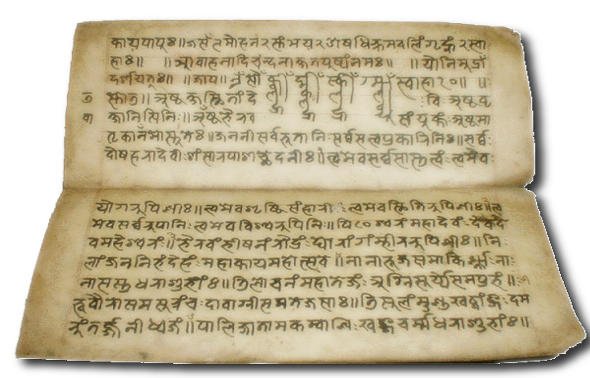
Here is a poem in which the first line tells the story of God Rama. Now read it backwards, syllable by syllable — becomes the next line AND this time, it tells the story of God Krishna!
This is not a trick pulled off in one clever line. It runs through all 36 verses of the poem. so we continue with all remaining lines doing this repeatedly – 36 times! It is a literary wonder where meaning, devotion and poetic brilliance flow in both directions!
The work is called Rama Krishna Viloma Kavyam – Viloma means “against the grain” or “reversed”. Continue reading to see how it works, who wrote it, and what is it about Sanskrit that makes such a thing even possible in the first place!
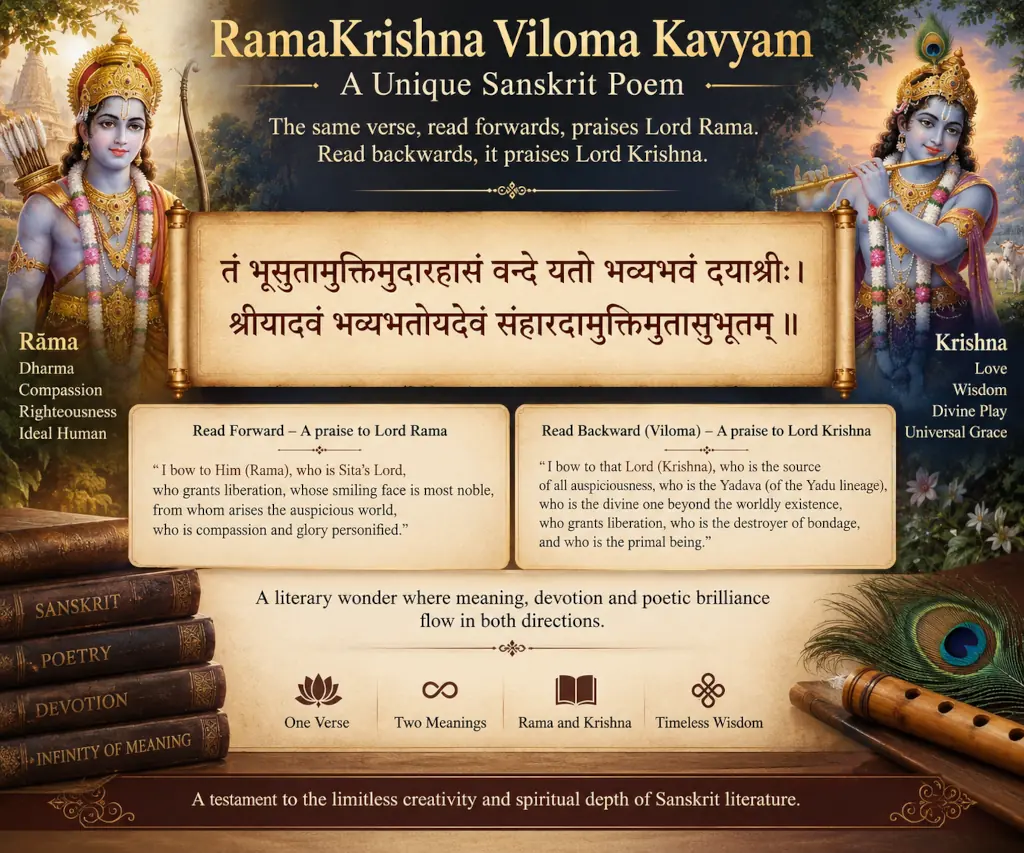
The first verse
तं भूसुतामुक्तिमुदारहासं वन्दे यतो भव्यभवं दयाश्रीः ।
श्रीयादवं भव्यभतोयदेवं संहारदामुक्तिमुतासुभूतम् ॥ १॥
The first line is about Rama – bhusuta, “the daughter of the Earth”, is Sita, and vande is “I bow to him”. The second line is about Krishna – Sri Yadava.
Observe that the 2nd line is an exact reverse of the syllables in the first! The first half of the verse hence, is the story of Rama, run it in reverse and it becomes the second half of the verse, and IS the story of Krishna!
What exactly is being reversed?
Not the letters. The syllable – what Sanskrit calls an akṣara, a consonant (or a cluster of consonants) together with its vowel. That is why kti in mukti travels as one block in both directions.
Look closely at the table and you will spot three tiny changes at word-ends: taṃ becomes tam, śrīḥ becomes śrī, van becomes vaṃ. This isnt cheating. They are the usual sandhi rules of Sanskrit – the last sound of a word adjusts itself to whatever word comes next, it is about how we join words in Sanskrit. Change the neighbor, and the ending changes. Everything else is untouched.
Verses like these, where the reversed half sounds different from the original half, are called viṣamākṣara. The poem also contains the other kind, and that is where it gets truly unbelievable!
Verse 31 – a palindrome inside a palindrome!
शङ्कावज्ञानुत्वनुज्ञावकाशं याने नद्यामुग्रमुद्याननेया ।
याने नद्यामुग्रमुद्याननेया शङ्कावज्ञानुत्वनुज्ञावकाशम् ॥ ३१॥
Read the first line backwards: śaṃ-kā-va-jñā-nu-tva-nu-jñā-va-kā-śaṅ. It is the same line. Each line here is itself a palindrome. So the second half of the verse sounds exactly like the first half – and still the first half is about Rama and the second about Krishna, because the same stream of sound is cut into different words in each half. This trick is called samākṣara in Sanskrit. How you group aksharas together (word segmentation) alters the meaning of the sentence!
Think about what the poet has done here. He has written a sentence that, read in reverse, sounds identical to itself and means something completely different.
Who wrote it, and when?
Most websites online will tell you this is a 14th century work. It is not. The author, Suryadasa – also known as Sūrya Daivajña or Sūrya Paṇḍita – was born in 1508 at Pārthapura on the banks of the Godavari, in present-day Maharashtra. The poem was composed towards the end of the 16th century, around 1580.
And here is the part that should not surprise anyone who knows how ancient Indian scholarship worked: Sūryadāsa was not primarily a poet. He was a mathematician and astronomer, the son of the astronomer Jnanaraja, and the author of Suryaprakasha, a commentary on mathematician Bhaskara’s Beejaganita (algebra). The man who made a poem run backwards also spent his days solving math problems!
Christopher Minkowski, who held the Boden Professorship of Sanskrit at Oxford, studied every known viloma kavya and concluded that Suryadasa did not merely write one – he invented the genre. Every later work of this type – Chidambara’s Shabdarthacintamani (c. 1600), Venkatadhvarin’s Raghavayadaviya (c. 1650), etc came after him.
The meter must work backwards as well!
Each verse has four lines of 11 syllables – 44 in all. The pattern is Indravajra (mixed with Upendravajra the form is called Upajati), a classical meter descended from the Vedic Triṣṭubh. So, it is not just the syllables (akshara) that should make sense in reverse, but the meter of the poem should remain valid as well!
Now here is a constraint that is easy to miss. Sanskrit meter depends on whether each syllable is “heavy” (Guru) or “light” (Laghu), and a syllable’s weight depends partly on what comes AFTER it – a short vowel followed by a consonant cluster becomes heavy. Reverse the syllables and the neighbors change, so the weights do not simply reverse along with them. The poet had to make sure that the rhythm held in both directions at the same time as the meaning. Three locks, one key!
What is it about Sanskrit that makes this possible?
Try it in English. Take any sentence about Rama, reverse its syllables, and see if you get anything at all, let alone a sentence about Krishna. You won’t. Try if you can somehow make up such sentences. You can’t. So what does Sanskrit have that English does not?
1. It is built from syllables, not letters. The akshara is the natural unit of the Sanskrit (and all Indian languages as well) – how it is written, chanted and memorized all are done akshara-wise. A syllable-by-syllable reversal is a natural operation in Sanskrit in a way which is not possible in an alphabetic language.
2. Words are not fixed by spaces. A line of Sanskrit verse is one continuous stream of sound joined by sandhi. The reader decides where one word ends and the next begins. The same stream can be cut in more than one way – which is exactly what verse 31 exploits. There is a whole tradition of Shlesha poetry built on this, where one text carries two stories at once; Kaviraja’s Raghavapandaviya (12th century) tells the Ramayana and the Mahabharata simultaneously in same words! Suryadasa’s twist was to put the two stories in opposite directions instead of on top of each other!
3. Word order is free. In English, “Rama killed Ravana” and “Ravana killed Rama” are two different events. In Sanskrit the ending of each word tells you who did what to whom, so the words can appear in any order and still make the same sentence. A poet who reverses a line does not lose the grammar – he only has to make sure the reversed syllables still form words.
4. A vast stock of synonyms and multiple meanings. Sita can be Bhusuta, Janaki, Vaidehi, Maithili. Krishna can be Yādava, Mādhava, Keśava, Govinda. When you need a particular chain of syllables to appear at a particular place, having ten names for every character is not decoration – it is raw material.
5. Compounds of any length. Sanskrit strings words together into single compounds (samāsa) that can be split in more than one way. A long compound is a long stretch of syllables with flexible joints.
Put all five together and a viloma kāvya stops looking like magic and starts looking like engineering – extremely difficult engineering, done with a language that was built to allow it.
Is this just a party trick?
The usual objection: fine, it is clever, but is it poetry? This is the wrong question. Works like these belong to a recognised branch of Sanskrit literature called citrakāvya, “picture poetry”, where the form itself is the achievement. Nobody asks whether a chess problem is a “real” game.
And the poet knew exactly what he had done. In his final verse Sūryadāsa says that a sage once made the Godavari flow east from the Sahyadri mountains to the sea – but could even that sage make the river flow back to its source? He asks those who understand poetry to recognise that this work marks the very limit of what citrakāvya can do.
He was writing on the banks of that same Godavari. He had just made a river of words flow uphill.
No wonder that Sanskrit, a language that was the medium of instruction in ancient India, is a treasure trove of knowledge.
Summary
- Rama Krishna Viloma Kavyam: 36 verses, each in 44 syllables (4 lines × 11, Indravajrā/Upajāti meter).
- First half of each verse is about Rama; second half is the first half reversed syllable by syllable, and is about Krishna.
- Author: Sūryadāsa (Sūrya Daivajña / Sūrya Paṇḍita), born 1508 at Pārthapura on the Godavari – a mathematician-astronomer. The poem dates to around 1580, NOT the 14th century.
- He invented the viloma kāvya genre; all other known examples came later.
- Sanskrit makes this possible through syllable-based structure, sandhi, free word order, enormous vocabulary and flexible compounds.
The Complete Rama Krishna Viloma Kavyam
तं भूसुतामुक्तिमुदारहासं वन्दे यतो भव्यभवं दयाश्रीः ।
श्रीयादवं भव्यभतोयदेवं संहारदामुक्तिमुतासुभूतम् ॥ १॥
चिरं विरञ्चिर्न चिरं विरञ्चिः साकारता सत्यसतारका सा ।
साकारता सत्यसतारका सा चिरं विरञ्चिर्न चिरं विरञ्चिः ॥ २॥
तामसीत्यसति सत्यसीमता माययाक्षमसमक्षयायमा ।
माययाक्षसमक्षयायमा तामसीत्यसति सत्यसीमता ॥ ३॥
का तापघ्नी तारकाद्या विपापा त्रेधा विद्या नोष्णकृत्यं निवासे ।
सेवा नित्यं कृष्णनोद्या विधात्रे पापाविद्याकारताघ्नी पताका ॥ ४॥
श्रीरामतो मध्यमतोदि येन धीरोऽनिशं वश्यवतीवराद्वा ।
द्वारावतीवश्यवशं निरोधी नयेदितो मध्यमतोऽमरा श्रीः ॥ ५॥
कौशिके त्रितपसि क्षरव्रती योऽददाद्ऽद्वितनयस्वमातुरम् ।
रन्तुमास्वयन तद्विदादयोऽ तीव्ररक्षसि पतत्रिकेशिकौ ॥ ६॥
लम्बाधरोरु त्रयलम्बनासे त्वं याहि याहि क्षरमागताज्ञा ।
ज्ञातागमा रक्ष हि याहि या त्वं सेना बलं यत्र रुरोध बालम् ॥ ७॥
लङ्कायना नित्यगमा धवाशा साकं तयानुन्नयमानुकारा ।
राकानुमा यन्ननु यातकंसा शावाधमागत्य निनाय कालम् ॥ ८॥
गाधिजाध्वरवैरा ये तेऽतीता रक्षसा मताः ।
तामसाक्षरतातीते ये रावैरध्वजाधिगाः ॥ ९॥
तावदेव दया देवे यागे यावदवासना ।
नासवादवया गेया वेदे यादवदेवता ॥ १०॥
सभास्वये भग्नमनेन चापं कीनाशतानद्धरुषा शिलाशैः ।
शैलाशिषारुद्धनताशनाकी पञ्चानने मग्नभये स्वभासः ॥ ११॥
न वेद यामक्षरभामसीतां का तारका विष्णुजितेऽविवादे ।
देवाविते जिष्णुविकारता का तां सीमभारक्षमयादवेन ॥ १२॥
तीव्रगोरन्वयत्रार्यो वैदेहीमनसो मतः ।
तमसो न महीदेवै- र्यात्रायन्वरगोव्रती ॥ १३॥
वेद या पद्मसदनं साधारावततार मा ।
मारता तव राधा सा नन्द सद्मप यादवे ॥ १४॥
शैवतो हननेऽरोधी यो देवेषु नृपोत्सवः ।
वत्सपो नृषु वेदे यो धीरोऽनेन हतोऽवशैः ॥ १५॥
नागोपगोऽसि क्षर मे पिनाकेऽ नायोऽजने धर्मधनेन दानम् ।
नन्दानने धर्मधने जयो ना केनापि मे रक्षसि गोपगो नः ॥ १६॥
ततान दाम प्रमदा पदाय नेमे रुचामस्वनसुन्दराक्षी ।
क्षीरादसुं न स्वमचारु मेने यदाप दाम प्रमदा नतातः ॥ १७॥
तामितो मत्तसूत्रामा शापादेष विगानताम् ।
तां नगाविषदेऽपाशा मात्रासूत्तमतो मिता ॥ १८॥
नासावद्यापत्रपाज्ञाविनोदी धीरोऽनुत्या सस्मितोऽद्याविगीत्या ।
त्यागी विद्यातोऽस्मि सत्त्यानुरोधी दीनोऽविज्ञा पात्रपद्यावसाना ॥ १९॥
सम्भावितं भिक्षुरगादगारं याताधिराप स्वनघाजवंशः ।
शवं जघान स्वपराधिताया रङ्गादगारक्षुभितं विभासम् ॥ २०॥
तयातितारस्वनयागतं मा लोकापवादद्वितयं पिनाके ।
केनापि यं तद्विदवाप कालो मातङ्गयानस्वरतातियातः ॥ २१॥
शवेऽविदा चित्रकुरङ्गमाला पञ्चावटीनर्म न रोचते वा ।
वातेऽचरो नर्मनटीव चापं लामागरं कुत्रचिदाविवेश ॥ २२॥
नेह वा क्षिपसि पक्षिकन्धरा मालिनी स्वमतमत्त दूयते ।
ते यदूत्तमतम स्वनीलमा- राधकं क्षिपसि पक्षिवाहने ॥ २३॥
वनान्तयानस्वणुवेदनासु योषामृतेऽरण्यगताविरोधी ।
धीरोऽवितागण्यरते मृषा यो सुनादवेणुस्वनयातनां वः ॥ २४॥
किं नु तोयरसा पम्पा न सेवा नियतेन वै ।
वैनतेयनिवासेन पापं सारयतो नु किम् ॥ २५॥
स नतातपहा तेन स्वं शेनाविहितागसम् ।
सङ्गताहिविनाशे स्वं नेतेहाप ततान सः ॥ २६॥
कपितालविभागेन योषादोऽनुनयेन सः ।
स नये ननु दोषायो नगे भाविलतापिकः ॥ २७॥
ते सभा प्रकपिवर्णमालिका नाल्पकप्रसरमभ्रकल्पिता ।
ताल्पिकभ्रमरसप्रकल्पना कालिमर्णव पिक प्रभासते ॥ २८॥
रावणेऽक्षिपतनत्रपानते नाल्पकभ्रमणमक्रमातुरम् ।
रन्तुमाक्रमणमभ्रकल्पना तेन पात्रनतपक्षिणे वरा ॥ २९॥
दैवे योगे सेवादानं शङ्का नाये लङ्कायाने ।
नेयाकालं येनाकाशं नन्दावासे गेयो वेदैः ॥ ३०॥
शङ्कावज्ञानुत्वनुज्ञावकाशं याने नद्यामुग्रमुद्याननेया ।
याने नद्यामुग्रमुद्याननेया शङ्कावज्ञानुत्वनुज्ञावकाशम् ॥ ३१॥
वा दिदेश द्विसीतायां यं पाथोयनसेतवे ।
वैतसेन यथोपायं यन्तासीद्ऽविशदे दिवा ॥ ३२॥
वायुजोऽनुमतो नेमे सङ्ग्रामेऽरवितोऽह्नि वः ।
वह्नितो विरमे ग्रासं मेनेऽतोऽमनुजो युवा ॥ ३३॥
क्षताय मा यत्र रघोरितायु- रङ्कानुगानन्यवयोऽयनानि ।
निनाय यो वन्यनगानुकारं युतारिघोरत्रयमायताक्षः ॥ ३४॥
तारके रिपुराप श्री- रुचा दाससुतान्वितः ।
तन्वितासु सदाचारु श्रीपुरा पुरि के रता ॥ ३५॥
लङ्का रङ्काङ्गराध्यासं याने मेया काराव्यासे ।
सेव्या राका यामे नेया सन्ध्यारागाकारं कालम् ॥ ३६॥
॥ इति श्रीदैवज्ञपण्डित सूर्यकवि विरचितं विलोमाक्षररामकृष्णकाव्यं समाप्तम् ॥
Notes
1. Sūryadāsa’s Sūryaprakāśa (1538) is a commentary on the Bījagaṇita of Bhāskara II. See Pushpa Kumari Jain, The Sūryaprakāśa of Sūryadāsa: A Commentary on Bhāskarācārya’s Bījagaṇita, Vol. 1, Oriental Institute, Vadodara, 2001. His father Jñānarāja, also of Pārthapura, wrote the astronomical treatise Siddhāntasundara (1503).
References
- Christopher Minkowski, “On Sūryadāsa and the Invention of Bidirectional Poetry (vilomakāvya)”, Journal of the American Oriental Society 124(2), 2004, pp. 325–333. https://www.jstor.org/stable/4132220
- Daivajña Śrī Sūrya Kavi, Rāma-kṛṣṇa-viloma-kāvyam, with Sanskrit and Hindi commentary by Dr. Kameshwar Nath Mishra, Chaukhamba Sanskrit Series Office, Varanasi, 1970. https://archive.org/details/rama_krishna_viloma_kavyam
- Daivagnya Suri, Ramakrishnakhyam Viloma Kavyam, with the author’s own commentary, Amar Press, 1890. https://archive.org/details/PuDh_ramakrishnakhyam-viloma-kavyam-by-daivagnya-suri-1890-amar-press
- Yigal Bronner, Extreme Poetry: The South Asian Movement of Simultaneous Narration, Columbia University Press, 2010.
- Wikipedia, “Rāmakṛṣṇavilomakāvyaṃ”. https://en.wikipedia.org/wiki/Rāmakṛṣṇavilomakāvyaṃ